The Projects · 04 · Kasarani, Naivasha
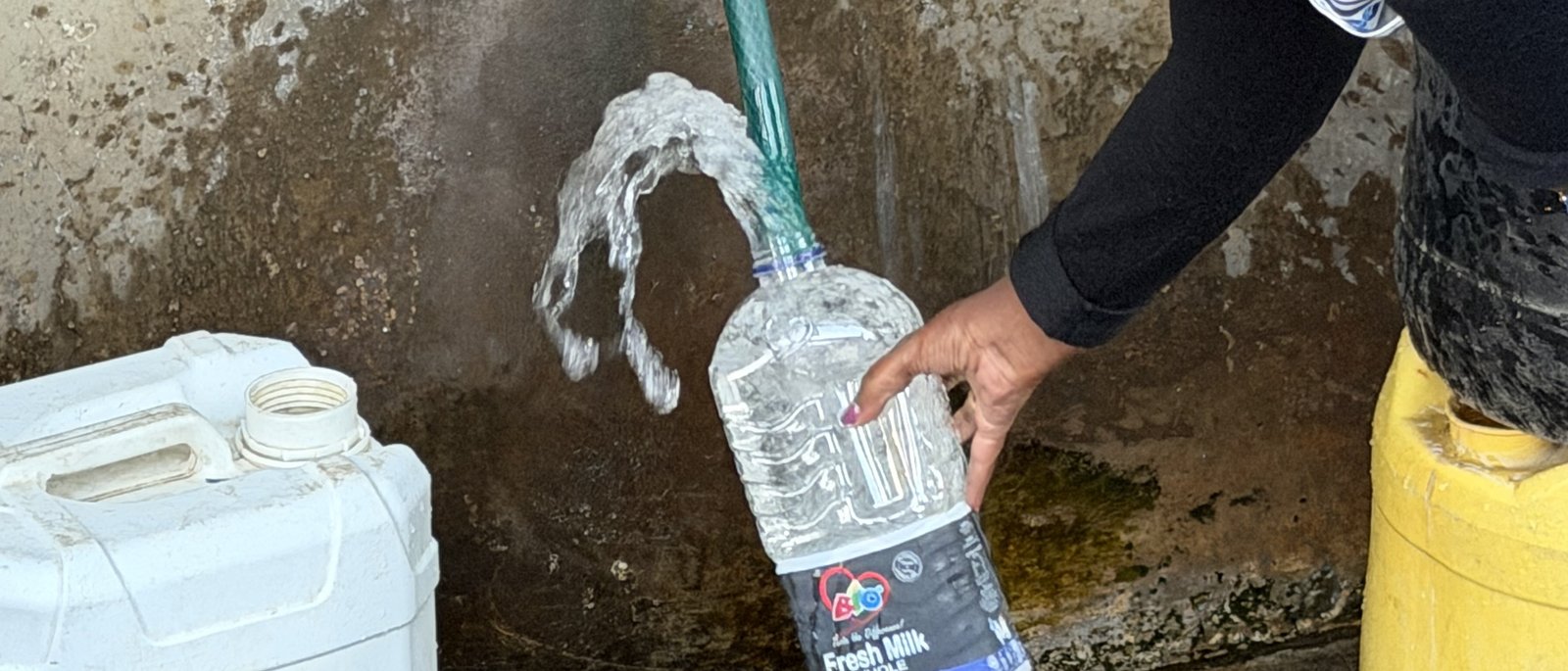
The water is clear. It is not safe.
In Kasarani, an informal settlement of some thirty thousand people on the shore of Lake Naivasha, every community borehole draws water containing roughly twice to nearly three times the WHO limit for fluoride — natural contamination from the Rift Valley’s volcanic rock that visibly stains children’s teeth and, a growing body of evidence indicates, is associated with reduced cognitive development.
We are building a practical response: a community-owned kiosk supplying fluoride-safe drinking water, designed and documented carefully enough to matter far beyond one settlement. Commissioning of the first phase is targeted for around the end of 2026.
The problem
For reference: the WHO guideline and Kenyan standard (KS EAS-12) is 1.5 mg/L. Every source exceeds it — roughly two to nearly three times over.
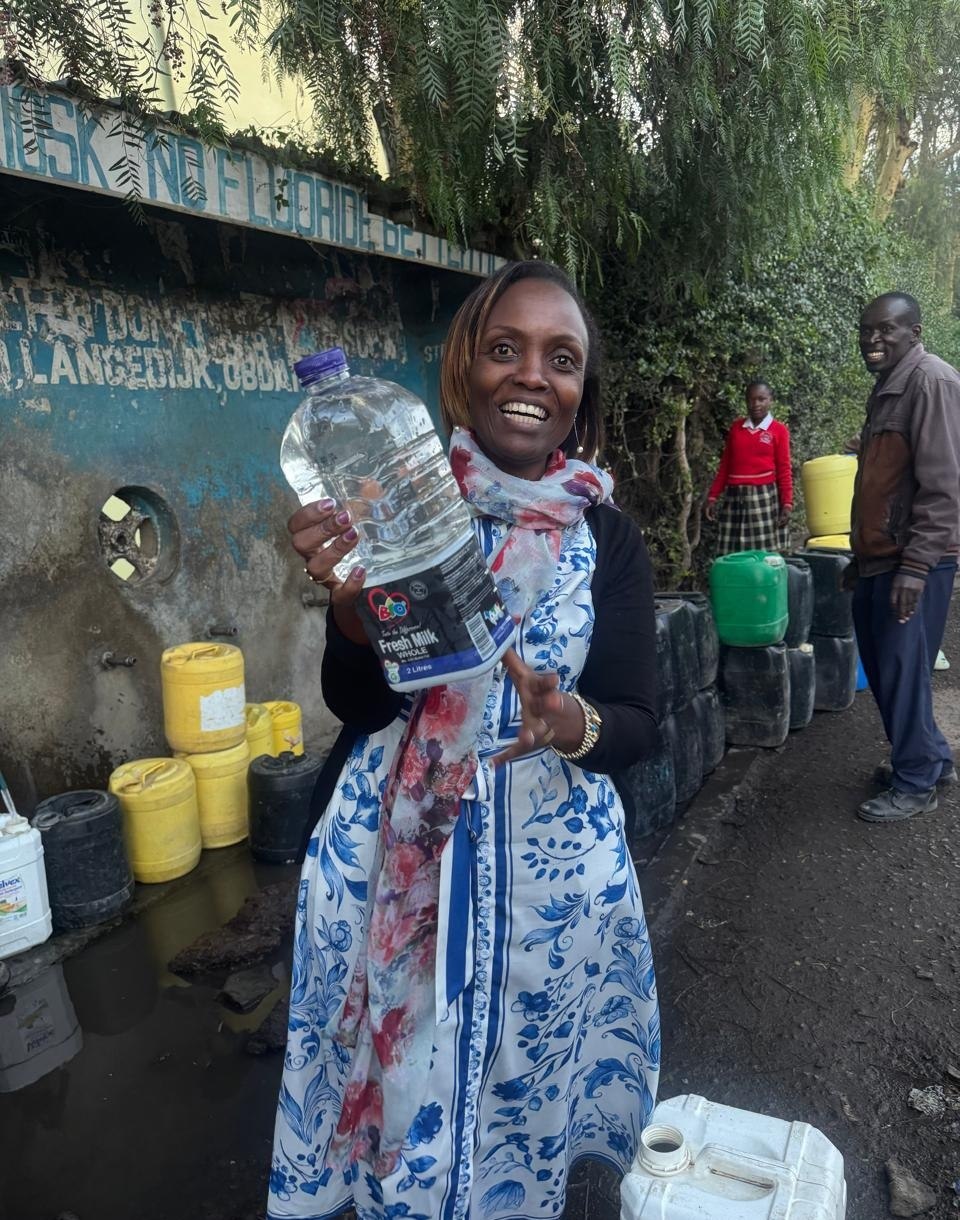
In June 2026, Kasarani’s three community boreholes were sampled and tested by the Kenya Water Institute (KEWI), a Kenyan government water-sector institution. Every source failed — the readings above, roughly twice to nearly three times the safety limit. The contamination is geological, not man-made: the volcanic rocks of the East African Rift release fluoride into groundwater across the region. And it is invisible — at these concentrations, fluoride cannot be seen, smelled, or tasted.
Part of the harm is already visible. Dental fluorosis — permanent staining and mottling of teeth caused by childhood exposure — is widespread in Kasarani. Residents raise it unprompted; in Kenya it carries real costs to confidence and employment. What cannot be seen is what the newest science points to.
And the gravest risk is timed, not general. Fluoride crosses the placenta: the exposure that matters most happens in the womb, as a pregnant mother drinks the water, and in the first years of life — in formula mixed with borehole water, in a toddler’s cup — while a child’s brain and teeth are still forming. An adult who switches to safe water gains little back; a child who never drinks the contaminated water never runs the risk. Protection, to work, has to reach the right people at the right time.
The evidence
In January 2025, scientists from the U.S. National Institutes of Health published a systematic review and meta-analysis in JAMA Pediatrics (Taylor et al.): 74 epidemiological studies, roughly 21,000 children. Sixty-four of the 74 studies reported inverse associations between fluoride exposure and children’s IQ. Among studies with individual-level exposure measurement, IQ was an estimated 1.63 points lower (95% CI, −2.33 to −0.93) per 1 mg/L increase in urinary fluoride — an association that held in the subset of studies rated at low risk of bias, and across analyses restricted to lower exposure ranges. In drinking-water terms the association was null below 1.5 mg/L — the open scientific questions in this literature concern low exposures, and the meta-analysis has been debated since publication, as strong findings should be. Neither changes the picture here: Kasarani’s water is at roughly twice to nearly three times that level, where the evidence is most consistent. Long-term exposure in this range also causes dental fluorosis and, over decades, can lead to skeletal fluorosis.
The scale of the problem is mapped but unaddressed. A global analysis published in Nature Communications (2022) estimates that around 180 million people drink groundwater exceeding 1.5 mg/L fluoride, concentrated in Asia and Africa, with the East African Rift among the most severe hotspots on earth. Yet not one of the meta-analysis’s 74 studies was conducted in Africa — 45 come from China, 12 from India, the rest from Iran, Mexico, Canada, and elsewhere. The nearest work is a single research program in Ethiopia’s Rift Valley. And to our knowledge, no one anywhere has published a community-scale defluoridation intervention with exposure measured before and after.
The evidence, at a glance
−1.63 IQ points per 1 mg/L increase in urinary fluoride (95% CI −2.33 to −0.93 · Taylor et al., JAMA Pediatrics, 2025)
Where the meta-analysis’s 74 studies were conducted
Kasarani’s boreholes against the limit (fluoride, mg/L)
The continent with the worst exposure has the least evidence — and the world has no demonstration that removing the fluoride measurably reduces the dose children carry.
The project
Phase 1 — targeted for commissioning around the end of 2026 — is a solar/grid hybrid treatment system (reverse osmosis is the proposed technology; final selection is undergoing independent engineering review) treating borehole water to well below 1.5 mg/L fluoride, dispensed from a community water kiosk with storage, and operated as a community-owned social enterprise designed to cover its own operating costs.
The implementing partner is Water for the World, a water-focused nonprofit whose Kenyan operations run as a social enterprise under Managing Director Justus Waimiri. W4W identified the problem, commissioned the KEWI testing, and holds the community relationships, working alongside the TAFA Community Center and the area chief. Treated-water quality will be verified by periodic independent laboratory testing, not assumed.
Because the neurodevelopmental risk concentrates in pregnancy and early childhood, the planned design routes a free daily entitlement of drinking and cooking water to pregnant women and families with young children, registered through the local health facility, with tiered pricing and per-household caps for all other users. This reflects one of the most consistent findings in safe-water research: even small prices screen out precisely the households that most need protection. The design exists to prevent that — and to prevent scarce treated water from being bought in bulk for uses that don’t require it. In practice, the kiosk and the local health clinic would work as one system: a mother registers her pregnancy at the clinic, and safe water follows her home — free — through her child’s earliest years.
Status, plainly
Confirmed
The laboratory results, the implementing partner, and the community partnership.
In progress
Independent technical review of the engineering design, and engagement with the local water utility (NAIVAWASCO) and Nakuru County, whose own fluoride-mitigation ambitions we intend to complement, not duplicate.
Intended, not yet agreed
A Kenyan-university-led research component — baseline measurement of urinary fluoride and dental fluorosis before commissioning, with follow-up rounds after — for which no university partner or ethics clearance is yet in place. Any research will be led by Kenyan institutions, conducted with community consent under Kenyan ethical review, and published regardless of what it shows.
We will maintain this distinction between what is done, what is underway, and what is intended as the project develops.
The bigger picture
The world spends roughly nine billion dollars a year on water and sanitation aid. Essentially none of it addresses naturally occurring fluoride: no major funder, no flagship program, no institutional champion, for a contaminant affecting an estimated 180 million people.
There is a precedent for how that changes. A decade ago, childhood lead poisoning in low-income countries was similarly neglected; once credible exposure data, working demonstrations, and cost-per-outcome economics existed, it became an international priority — anchored by the Lead Exposure Action Fund, launched in 2024 with over $100 million. Fluoride today has the science but none of the other three pieces.
Kasarani is designed to supply the demonstration: one community, measured honestly, before and after, with its full costs published. If the model proves out, the case stops being theoretical.
For researchers and partners
If you work in environmental health, epidemiology, water treatment, or WASH and see something here worth strengthening — a flaw in our thinking included — we would like to hear from you: josh@talantaafrica.org.
Fund the demonstration.
Your gift builds both the water and the proof: treatment for a community, measured honestly — baseline, independent testing, and publication, whatever the results show.
Give to Safe Water